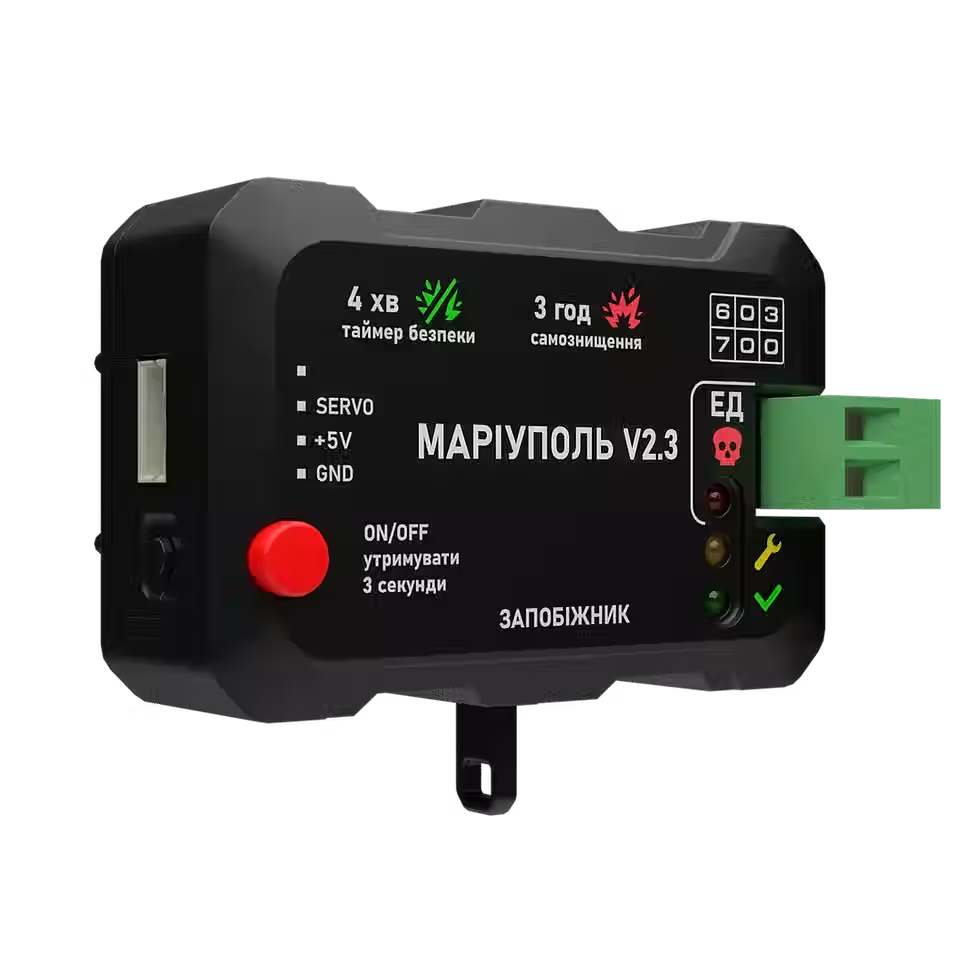
The MARIUPOL v1.2 initiator is designed to activate a charge by supplying more than 1500 mA to an electronic detonator. Activation can be inertial (on impact) via the accelerometer or manual via a PWM channel. ARM/DISARM can also be controlled from the transmitter via the PWM channel.
Note: INITIATION and ARM/DISARM use the same PWM channel and are controlled by a single servo output. See the manual for setup details.
Important: 30 minutes after the board is activated, a self-destruct signal is sent to the electronic detonator terminals.
Current model: MARIUPOL v2.3.
Archived product
Discontinued
Initiators
MARIUPOL v1.3
The MARIUPOL v1.3 initiator is designed for use in fixed-wing kamikaze UAVs and activates a charge by supplying more than 1500 mA to an electronic detonator. Activation can be inertial (on impact) via the accelerometer or manual via a PWM channel. ARM/DISARM control via a PWM channel is also supported. Please note: INITIATION and ARM/DISARM share the same PWM channel and are controlled by a single servo output. Connection to the flight controller and the use of ARM/DISARM are mandatory. If no PWM signal is detected at the SERVO input, the initiator reports a fault. Important: three hours after the board is activated, a self-destruct signal is sent to the electronic detonator terminals. Current model: MARIUPOL v2.3.


Button placement
The power button has been moved to the front panel to account for fixed-wing airframe layouts where the sides of the initiator may be inaccessible.

Quick-release terminal block
The vertical terminal block allows the detonator connection to be prepared in advance and is designed around the layout of fixed-wing UAVs.
550 mm cable
The three-pin cable is compatible with most fixed-wing flight controllers, and its length allows the initiator to be installed anywhere in the airframe.


PWM connection check
At startup, the initiator checks for a DISARM PWM signal (1000 µs) from the flight controller and reports a fault if the signal is absent.
Backup power
The initiator has a built-in CR123A 3 V battery and can also be powered through the +5 V contact. In this configuration, the battery is preserved and serves as backup power.


Timing and safety
The three-hour self-destruct timer is designed for long fixed-wing UAV missions. The safety timer is also longer because preparing a fixed-wing aircraft for launch takes more time than preparing a multirotor.
Initiator technical features

Self-diagnostics
On startup, the device performs self-diagnostics. It checks the accelerometer data, the presence of the safety pin, the battery charge level, the presence of a PWM signal, and the absence of an activation PWM signal at the Servo1 input.

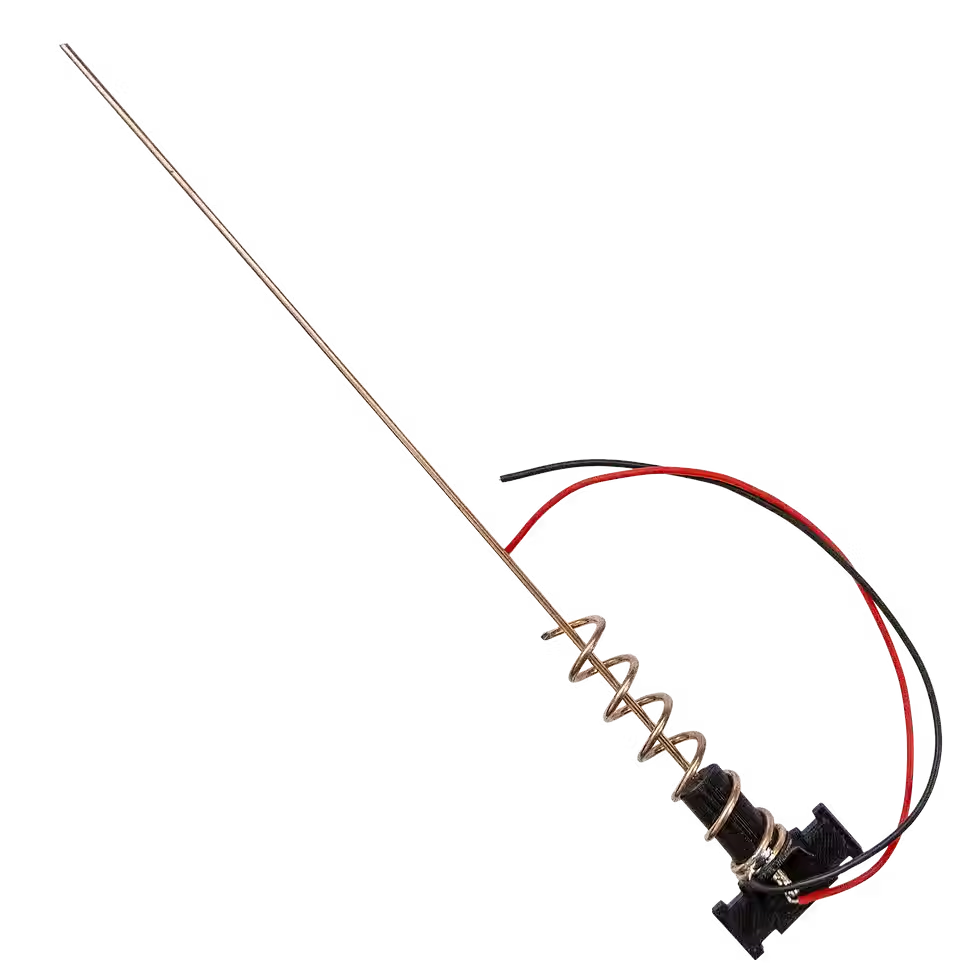
Mechanical safety pin
After the safety pin is removed, the 4-minute safety timer starts. If the pin is returned to its starting position, the device emits four short beeps, deactivates, and resets the safety timer.

Safety timer
During the safety timer, the device does not respond to overloads (impacts) or to the INITIATION command (1500 µs) from the transmitter.

Electronic safety
The final safety level is ARM/DISARM control from the transmitter via the PWM channel. After receiving the ARM signal (1000 µs), the device begins responding to overloads and to the initiation command from the transmitter.
4 levels of protection
Housing material
Molded plastic
Activation type
Inertial + PWM channel activation + self-destruct
Flight controller connection
JST-PH 2.0 to JR 3-pin, 550 mm (included)
Safety
Mechanical safety pin, ARM/DISARM via PWM channel
Maximum initiation current
>1500 mA
Power supply
Built-in CR123A 3 V battery or power from the flight controller
Safety timer
4 minutes after removing the mechanical safety pin
Status indication
Visual and audible
Self-destruct timer
3 hours after the last ARM command
Detonator connection
Self-clamping terminal block
Operating temperature
-20...+50 °C
Dimensions
65 × 43 × 23 mm (excluding protruding elements)
MARIUPOL v1.3 INITIATOR